While first-generation generative AI focused on conversational chat interfaces, the true enterprise value unlock lies in autonomous agentic systems: software entities capable of reasoning over complex business goals, decomposing tasks, and reliably invoking external APIs.
1. Moving from Prompting to Orchestration
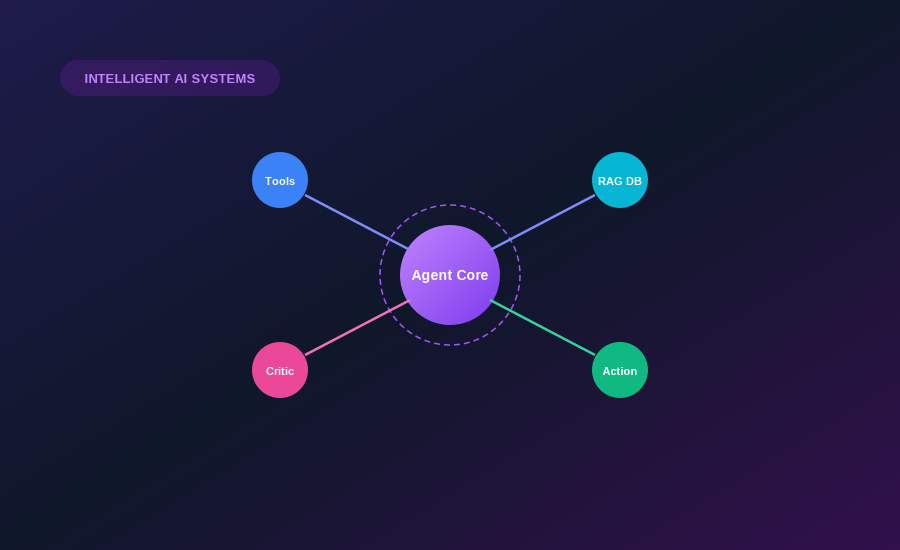
Single-turn prompt engineering fails when faced with multi-step enterprise workflows like insurance claims processing, code refactoring, or automated billing reconciliation. Our agentic architecture incorporates stateful execution graphs:
- Deterministic Tool Calling: Pydantic schema validation ensures agent API calls conform strictly to backend specifications without hallucinated parameters.
- Multi-Agent Verification: A primary generation agent proposes actions while an independent critic agent validates decisions against business rules before database writes.
- Hybrid Search (RAG): Combining dense vector embeddings (HNSW) with sparse lexical search (BM25) guarantees accurate domain knowledge retrieval.
2. Safety Guardrails & Human-in-the-Loop
Enterprise autonomy must never compromise accountability. High-impact operations (such as approving refunds above $5,000 or deploying production infrastructure) automatically trigger Human-in-the-Loop (HITL) authorization checkpoints through Slack or Microsoft Teams webhooks.